


Preparing for an Ofsted inspection isn’t just about policies, paperwork and what happens in the nursery room.
The condition and safety of your premises matter too.
Fire safety systems, water hygiene, gas appliances, electrical installations and nursery equipment all require checks. Just as importantly, your team needs to be able to demonstrate that those checks happened, when they happened, who completed them and what you did about any problems identified.
That means being inspection-ready isn't simply a case of doing the check.
You need to be able to evidence it.
To help, we've put together the key facilities and estates areas nursery managers, operations teams and early years providers should keep on top of, along with a downloadable checklist you can use to assess your own settings.
The exact requirements at each nursery will depend on the building, equipment and provision.
However, there are several major areas that early years providers should be paying particular attention to.
Fire safety is one of the most important areas to keep under control.
The EYFS safeguarding and welfare requirements include having an emergency evacuation procedure, appropriate fire detection and control equipment, clearly identifiable fire exits and unobstructed fire doors. Your wider fire-safety responsibilities also include having a fire risk assessment.
As part of your nursery compliance checks, consider:
The important part is what happens when one of those checks identifies a problem. Recording a failed check without assigning and resolving the resulting work still leaves a compliance gap.
Water safety can easily become a background task, particularly when a nursery has been operating from the same building for years.
But providers need to ensure that Legionella risks continue to be assessed and the appropriate control measures are actually carried out.
That can include keeping the Legionella risk assessment current, completing outlet temperature checks, inspecting and cleaning tanks where applicable, properly managing water-play equipment, and tracking remedial actions through to completion.
Nurseries should also think about periods when normal routines change.
For example, summer closures can interrupt normal flushing and checking schedules. Having recurring tasks rather than relying on somebody remembering them makes those gaps easier to prevent.
Where a nursery has gas installations or appliances, there are specific safety responsibilities to manage.
Your records should make it straightforward to establish whether the relevant safety checks are current, whether appliances are being serviced appropriately, and whether reported faults have been dealt with.
The practical question for a nursery manager is simple:
Could you find the relevant certificate quickly if you were asked for it today?
If the answer involves searching someone's inbox, checking a filing cabinet or calling a contractor, your evidence process could be stronger.
Electrical compliance isn't only about arranging periodic inspections.
Nurseries also need to consider the everyday condition of electrical equipment and installations, particularly where they are accessible to children.
Checks can include fixed wiring inspections, portable appliances, sockets and fixed electrics, emergency lighting and the management of remedial work identified during inspections.
Again, closing the loop matters.
If an inspection identifies remedial work, there should be a clear process for turning those findings into actions, assigning them to the appropriate person or contractor, and recording when they've been resolved.
Your building isn't the only thing that needs maintaining.
Cots, highchairs, prams, playground equipment and other assets used by children need appropriate inspection and servicing too.
Your routine checks should cover keeping servicing on schedule, immediately logging and taking faulty equipment out of use, maintaining servicing histories, and incorporating safer-sleep checks into day-to-day operations.
The goal is to move away from assumptions such as "someone checks that" and towards a record showing what was checked, by whom and when.
The five areas above aren't necessarily the end of your compliance responsibilities.
Depending on your nursery and premises, your schedule may also need to account for areas such as playground equipment, outdoor spaces and perimeter security, emergency lighting, kitchen and food preparation, hazardous substances and asbestos management.
This is why a generic list of annual certificates isn't enough.
Each setting needs to understand the checks applicable to its own building, assets and provision, then make sure those checks are happening on the appropriate schedule.
Imagine an inspector asks when a particular piece of equipment was last checked.
You know it was done.
But can you prove it?
A strong compliance record should make it possible to establish the scheduled and actual completion dates, who carried out the check, the supporting certificate or evidence, what happened to issues that were identified, and the history of that check over time.
That's where otherwise well-run settings can create unnecessary risk.
Evidence stored across paper folders, individual computers, email inboxes and contractor portals becomes difficult to retrieve. Overdue tasks can remain invisible, while remedial work may become disconnected from the inspection that originally identified it.
The aim should be much simpler:
An inspector asks. Your team can show them.
Rather than treating every certificate and safety check as a separate process, it helps to think of compliance as one repeating cycle.
Our nursery compliance guide breaks this into five stages:
Identify risk → Schedule → Complete & record → Remediate → Audit trail
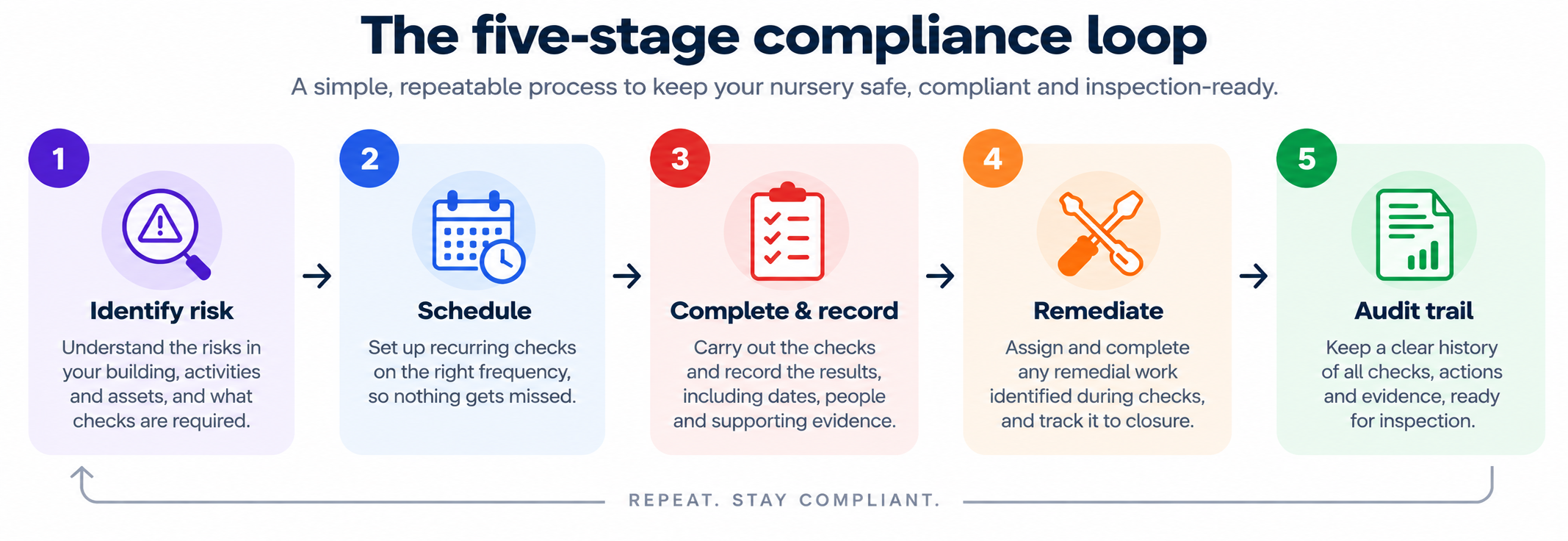
First, identify the room, activity or asset-level risk. Then schedule the appropriate check rather than relying on memory. Once completed, record the evidence. If a problem is identified, assign and close the remedial work. Finally, retain a history that can be retrieved when required.
This is where facilities management software can make a significant difference.
Instead of separate spreadsheets, paper records and calendar reminders, recurring compliance checks can be scheduled against the relevant building, room or asset. Evidence can be attached to the record, problems can become assigned jobs, and overdue activity can be made visible before it becomes an inspection-day surprise.
For nursery groups, there is another layer to consider.
A process that works reasonably well at one nursery can become difficult to control across ten or twenty settings.
Different managers can record information differently. Buildings have different histories. Certificates can live in different places. And finding out whether every nursery is compliant can turn into a round of emails and phone calls.
That's why group-level compliance needs consistency.
Operations and estates teams should ideally be able to see which settings are compliant, at risk or overdue, use consistent definitions across the group, identify recurring problems and understand the position of an unfamiliar setting without having to ask around.
There's also an important difference between reporting up and reporting out.
Leadership may need trends, outliers and group-wide risk information. An Ofsted inspector visiting one nursery needs an immediate, complete picture of that setting, including its history and supporting evidence.
Your compliance system needs to support both.
A useful test is to pick one setting and ask:
If not, that's where to start.
We've created a practical guide to help nursery groups and early years providers assess their current approach.
Staying Ofsted Compliant with a CAFM System covers the major facilities compliance areas discussed above and includes a consolidated setting-level self-assessment checklist covering fire, water, gas, electrical safety, equipment and documentation.
There's also a separate group-level checklist for operations and estates teams managing multiple settings.
Use it as a full compliance read-through, return to individual sections when preparing for an inspection, or take the checklist with you on a setting walk-round.
FaultFixers helps nursery and early years teams turn recurring facilities checks into scheduled, evidenced and auditable tasks, whether you're managing one setting or an entire nursery group.


