Staffing costs, agency fees and maintenance bills are easy to identify. They appear in budgets, reports and monthly accounts. But what about the costs that are harder to measure?
The hours spent rearranging rotas, chasing contractors, finding compliance documents and following up on jobs that should have been completed weeks ago. These tasks are necessary. The time wasted managing them isn't. And at a time when care providers are under pressure to control costs, that deserves more attention.
Consider a fairly ordinary morning in a care home.
A staff member calls in sick. The manager needs to arrange cover. Meanwhile, a repair reported last week still hasn't been completed, and someone is trying to locate a maintenance certificate. None of these problems are unusual. But each requires time, attention and follow-up.
The staffing cost is recorded. The repair invoice is recorded. The manager's time spent coordinating everything is rarely considered separately. That doesn't make it free.
When managers are repeatedly pulled into administrative tasks, they have less time to support their teams, speak with residents and families, and oversee the quality of care.
And this isn't just a problem for individual homes. For groups operating multiple sites, small inefficiencies can become expensive habits.
Recruitment, retention and agency costs remain major concerns for care providers.
But there's another question worth asking: how much additional work are we creating through the way staffing is managed?
When rotas, availability, training records and payroll information sit in different places, managers can spend unnecessary time checking information, contacting colleagues and correcting mistakes. Better workforce processes won't solve recruitment challenges. They can, however, reduce the administration surrounding them.

Dan Blake, Co-Founder of Florence:
"We spend a lot of time talking about staffing shortages in care, and rightly so. But we should also be asking how much time managers lose organising the workforce they already have. If we're serious about reducing pressure on care teams, that's something we need to address."
The point isn't that workforce management can be automated entirely. Staffing decisions still require judgement, particularly when residents have different needs.
It's about making sure managers have accurate information available when they need it, rather than having to piece it together themselves.
A pattern we see across Florence customers is that the providers who spend the least time chasing cover have agreed the order of escalation in advance: their own staff and bank first, then a short list of preferred agencies at agreed rates. Healthcare Ireland Group, for example, moved from 22 agencies to a core panel of nine. When that sequence runs automatically, the manager approves a booking rather than ringing round to find one.
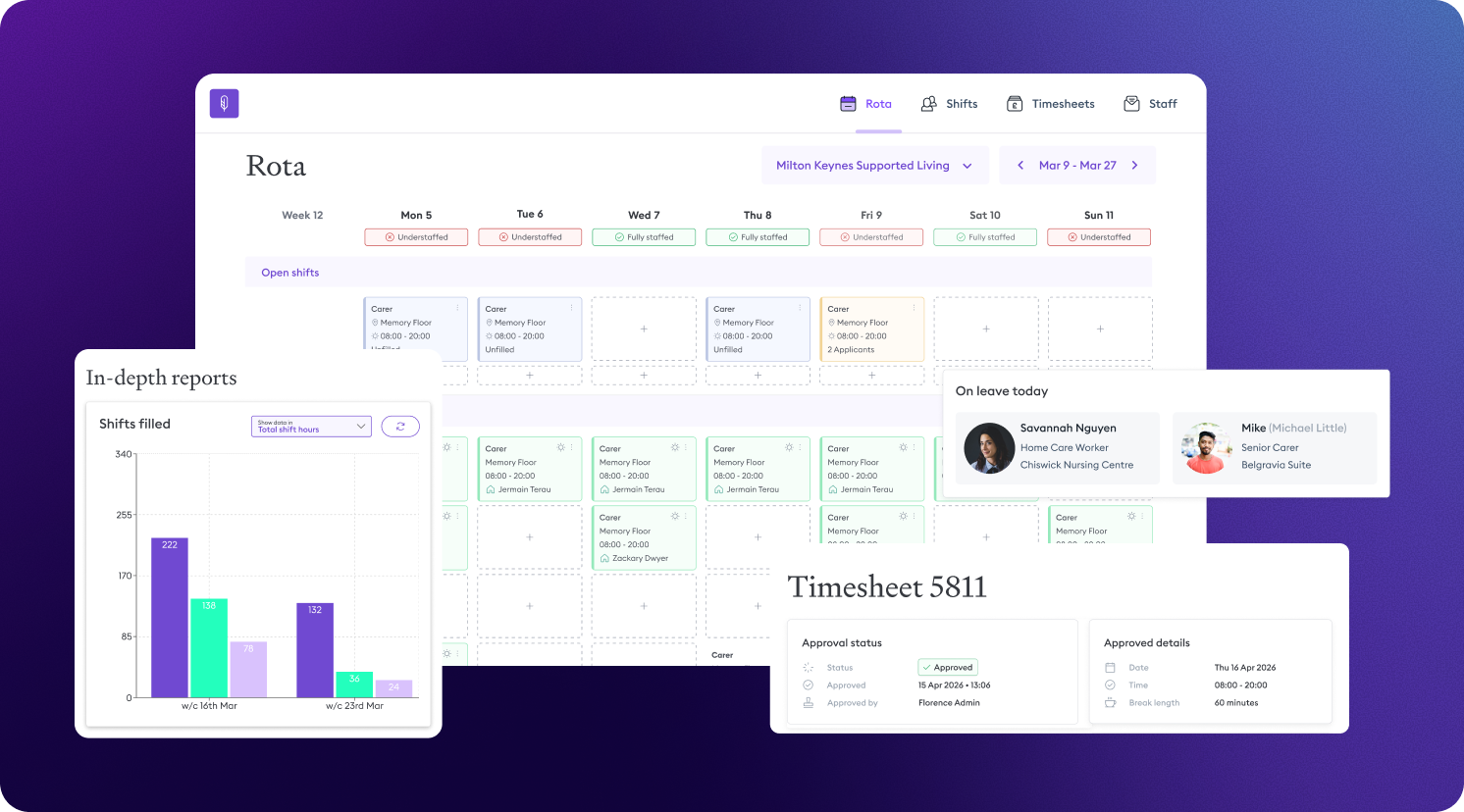
The difference can be measurable. Among Florence customers, We Care Group reduced agency hourly charge rates by 12% across 35 locations, Healthcare Ireland Group achieved a 6% saving on staffing costs across 25 care homes, and Hightown Housing Association cut the number of agencies it uses by a third. Florence's own platform data shows how often managers are firefighting cover. Of more than 1.3 million shifts posted on Florence in the 12 months to October 2026, around one in eight (12.7%) was posted less than 24 hours before it started, and four in ten (41%) less than a week before.
We Care Group shows how this works in practice. As the group grew to 35 care homes, its agency staffing had become fragmented, with several agencies, different processes at each home, and invoicing and compliance checks that took time to manage. Moving agency bookings into one neutral vendor system allowed it to standardise its agency panel and introduce a tiering system for its agencies. Invoicing was consolidated into a single invoice, compliance checks were automated, and the central finance team gained real-time data across every home. Since going live, its agency hourly charge rates have fallen by 12%.
This matters beyond the individual home. Regional managers and head office teams need the same information, prepared for them rather than requested each time: unfilled shifts over the coming week, agency use and spend against agreed rates by site, and training or compliance records that are about to expire. With that in front of them, they can act early, for example by moving staff between nearby homes or looking into a site where agency use is rising, instead of reacting once the cost has been incurred, or an inspection has found a gap. In Florence, the records managers use day to day feed these cross-site views directly, so no one has to compile a separate report for head office.
The same issue exists with property maintenance.
A broken lift or heating fault has an obvious impact. But there's also the work involved in getting it resolved. Who reported the issue? Has a contractor been contacted? When are they attending? Has the job actually been completed?
If those answers aren't easy to find, someone has to chase them. Often, that person is the care home manager. For providers operating multiple homes, this can become a significant administrative burden.
And when maintenance is handled reactively, the consequences can extend beyond the repair bill. Delays can disrupt staff, affect residents and turn relatively manageable issues into urgent problems.
For some care groups, bringing these processes together has already made a measurable difference. Athena Care, for example, reported around 20–30% faster response times for urgent maintenance jobs after moving away from requests that could get held up in email chains. The group also saves approximately 8–12 hours a week on administration and has reduced internal emails and follow-ups by around 30–40%. Dovehaven has seen similar operational benefits from centralising maintenance reporting, including fewer calls to clarify issues, fewer unnecessary assessment visits and better visibility of outstanding work across its homes.
The benefits extend to regional managers and head office teams, who are responsible for keeping track of maintenance activity across multiple locations. Without a shared view, understanding which repairs are outstanding, where delays are occurring or whether compliance records are up to date can mean contacting individual homes and gathering information manually. At Athena Care, maintenance teams and managers can now see the progress of reported jobs, including what is overdue and what has been completed. At Dovehaven, the ability to attach photos to maintenance requests helps teams assess problems earlier, while keeping records in one place makes information easier to retrieve when needed.
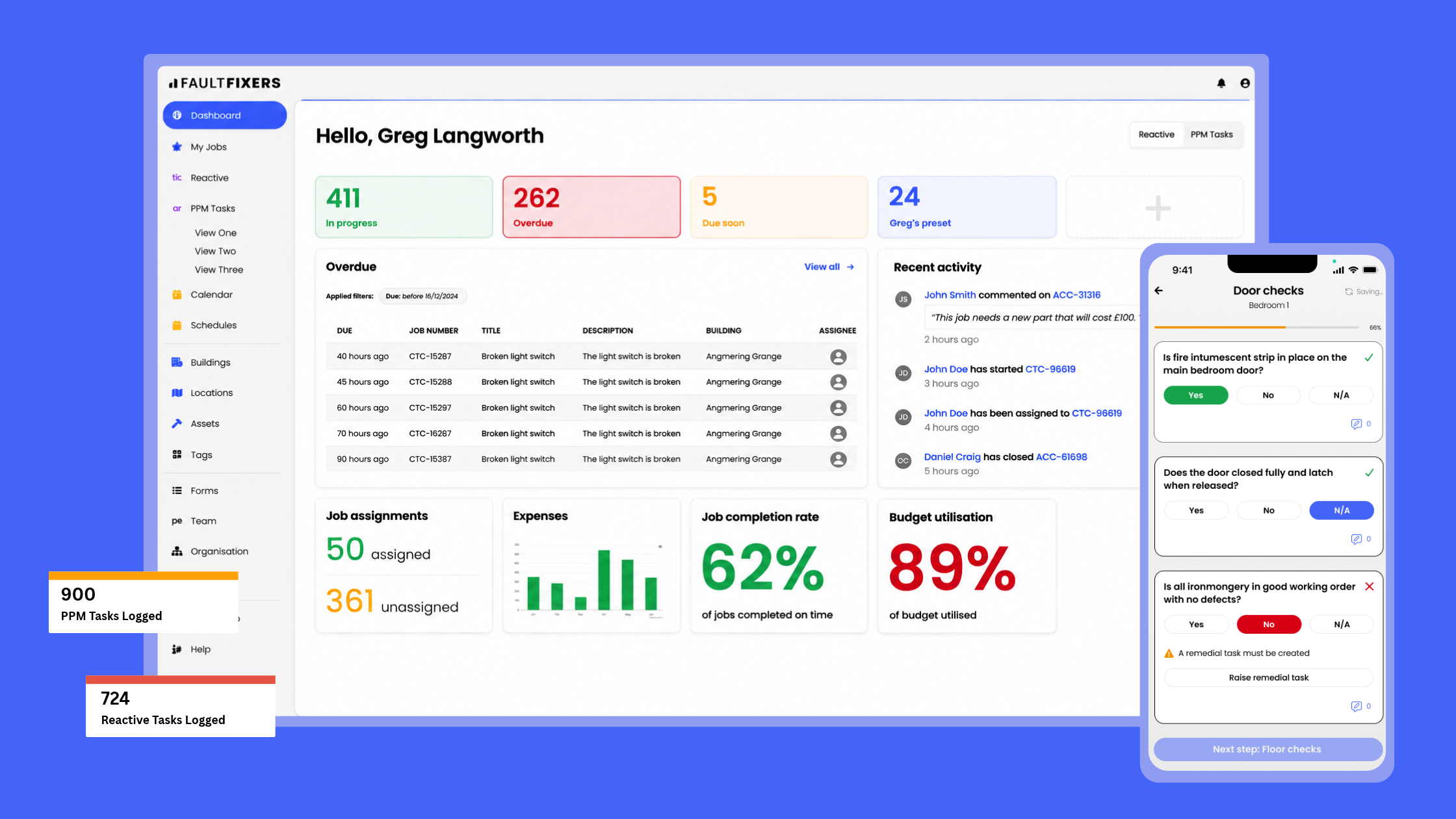
For care groups, the opportunity is not simply to complete repairs faster, but to reduce the administrative work surrounding them. By recording and tracking maintenance through FaultFixers, teams can spend less time searching for information or chasing progress, while senior managers have a clearer picture of what needs attention across their homes.

Tom O'Neill, CEO of FaultFixers:
"The repair itself is only part of the cost. There's also the time spent reporting it, chasing updates and checking whether it's been done. When that happens across several homes, it adds up. Maintenance needs to be managed properly, not just dealt with when someone complains."
The difference between reactive and well-managed maintenance isn't that faults stop happening. It's that issues are recorded, responsibilities are clear and people can see what's outstanding without repeatedly asking for updates.
Not every operational inefficiency is easy to put a figure on. But care providers can start by looking at where management time is going.
Here are four questions worth asking:
1. How often are managers chasing information?
Think about the time spent following up on contractor visits, checking staff availability or locating documents. If the same information is requested repeatedly, there's probably a process worth reviewing.
2. How many tasks depend on one person?
If a manager is off sick or on annual leave, can someone else quickly see outstanding maintenance jobs, upcoming deadlines and workforce requirements?
If not, the organisation may be relying too heavily on individual knowledge.
The same applies to workforce compliance. Training expiry dates, right-to-work checks and supervision records are easier to keep up to date, and to evidence at a CQC inspection, when they sit in one shared record rather than in one manager's spreadsheet or inbox.
3. Where are the same details being entered more than once?
Repeatedly updating spreadsheets, emails and separate systems creates additional work and increases the risk of mistakes.
On the workforce side, the most common example is hours worked being recorded several times over: on the rota, on a timesheet, in payroll, and again when an agency invoice is checked against the hours actually worked.
4. Are problems being identified early enough?
A planned maintenance task is generally easier to organise than an emergency repair. Similarly, spotting a staffing gap in advance gives managers more options than discovering it at the last minute.
For one week, ask managers to record the time they spend on avoidable follow-ups, duplicated data entry and searching for information.
Then calculate:
Hours spent × estimated hourly employment cost = estimated administrative cost
For example, if a manager spends five hours a week on these tasks, at an illustrative employment cost of £25 per hour, that's £125 a week. Across five homes, it becomes £625 a week, or approximately £32,500 a year.
For a real-world comparison, Healthcare Ireland Group reports saving 1,300 hours a year on financial and staffing administration across its 25 care homes after bringing bank, temporary staffing and agency management into one system. Cutting finance processing accounted for 130 of those hours.
That's not a forecast of potential savings. Some of that work will always be necessary, and the calculation doesn't account for every cost involved. But it shows why seemingly minor inefficiencies are worth measuring.
This isn't an argument for cutting back on staffing, maintenance or compliance. All three are essential to safe, high-quality care.
It's an argument for questioning the inefficient processes surrounding them.
Care providers are already looking closely at their spending. They should be looking just as closely at how much time their teams spend organising essential work. Florence and FaultFixers approach that challenge from different directions. Florence focuses on workforce management, while FaultFixers focuses on facilities maintenance.
Both areas require clear information, accountability and the ability to act before small issues become bigger problems. Care providers cannot eliminate every staffing challenge or prevent every building fault.
But they can reduce the time wasted dealing with them.
And when every hour and every pound matters, the cost of inefficient operations is one care providers can no longer afford to overlook.
Florence is a workforce management platform for health and social care, used by more than 2,000 care organisations. It brings rostering and time and attendance, HR and compliance, payroll export, Florence Academy training, Bank Manager and Agency Manager (a neutral vendor tool for agency staffing) together in one place, so managers can see staffing, spend and compliance across every site.
To learn more or book a demo please visit: https://www.florence.co.uk/
FaultFixers is a maintenance and compliance management platform designed for care providers managing one or multiple homes. It brings maintenance reporting, job tracking, contractor management, planned preventative maintenance and compliance records into one place, giving teams a clearer view of what needs attention and what has been completed. From everyday repairs to scheduled inspections and statutory checks, the platform helps care home managers keep track of maintenance responsibilities.
To learn more or book a demo please visit: https://www.faultfixers.com/