With updated fire door guidance in 2026 and further changes to fire resistance classification guidance approaching in 2029, care home maintenance managers have an opportunity to review how they manage inspections, maintenance and compliance records.
Fire door safety is a critical responsibility for care home maintenance and estates teams. In environments where residents may have reduced mobility or require assistance during an emergency, effective fire compartmentation plays an essential role in protecting lives.
However, managing fire doors across a busy care home can be challenging. From keeping track of inspection schedules and recording defects to ensuring remedial work is completed and maintaining accurate compliance documentation, there are numerous responsibilities to coordinate. For care home groups operating multiple properties, these challenges become even more complex.
But what exactly is changing, and how can care home maintenance managers prepare?
From 2 September 2029, amendments to Approved Document B (Fire Safety) in England are scheduled to remove references to the BS 476 national classification system for fire resistance.
The updated guidance will instead reference European fire resistance testing and classification standards, including BS EN 1634-1 and BS EN 13501-2. For maintenance managers, these changes will be particularly relevant when specifying new fire doors for future refurbishment and replacement projects. Traditionally, many fire doors have been classified as FD30 or FD60 under British Standards.
European fire resistance classifications use different terminology, such as E30 and EI30, depending on the performance demonstrated. These classifications are not automatically interchangeable, and new fire door specifications should be supported by appropriate testing and classification evidence. Importantly, the 2029 changes do not introduce a blanket requirement to replace every existing fire door. Existing doors may remain suitable where they continue to meet the building's fire safety requirements and are maintained in an appropriate condition. For care home maintenance managers, the immediate priority should therefore be understanding the condition, location and maintenance history of existing fire doors.
Alongside the upcoming 2029 changes, BS 8214:2026 brings updated industry guidance into focus. BS 8214 provides guidance relating to timber-based fire door assemblies, including their specification, installation and maintenance.
It is important to distinguish this British Standard from legislation. Industry standards can inform good practice and compliance decisions, but publication of a revised standard does not automatically create a new statutory obligation to replace existing doors. For care home estates teams, the practical message is to review existing fire door management arrangements against current guidance and the requirements identified through the premises' fire risk assessment.
This includes considering how inspections are recorded, how defects are reported and how maintenance work is tracked through to completion. Rather than treating compliance as a series of isolated inspections, maintenance managers should consider whether they have a reliable process for managing each fire door throughout its service life.
Care homes present unique fire safety challenges. Many residents may be unable to evacuate independently, and staff may need to assist with moving people to protected areas. In premises using progressive horizontal evacuation, fire-resisting compartment boundaries are especially important. Fire doors help maintain these boundaries by limiting the spread of fire and smoke.
However, care home fire doors are often exposed to considerable daily wear and tear. Wheelchairs, mobility aids, beds and equipment trolleys can cause damage to door leaves, frames and ironmongery. Self-closing devices may become defective, seals can deteriorate and repeated use can affect door alignment. If these issues are not identified and addressed, the performance of a fire door may be compromised.
For maintenance managers, the challenge is not simply identifying defects. It is ensuring that every reported issue is properly recorded, prioritised, assigned and resolved.
Fire door inspections are an important part of maintaining a safe care environment. Under the Regulatory Reform (Fire Safety) Order 2005, responsible persons must ensure that relevant fire safety precautions are maintained. Inspection arrangements should be appropriate to the premises and informed by factors such as the fire risk assessment, door condition, usage and relevant maintenance guidance. For care home maintenance teams, this creates several ongoing administrative challenges.
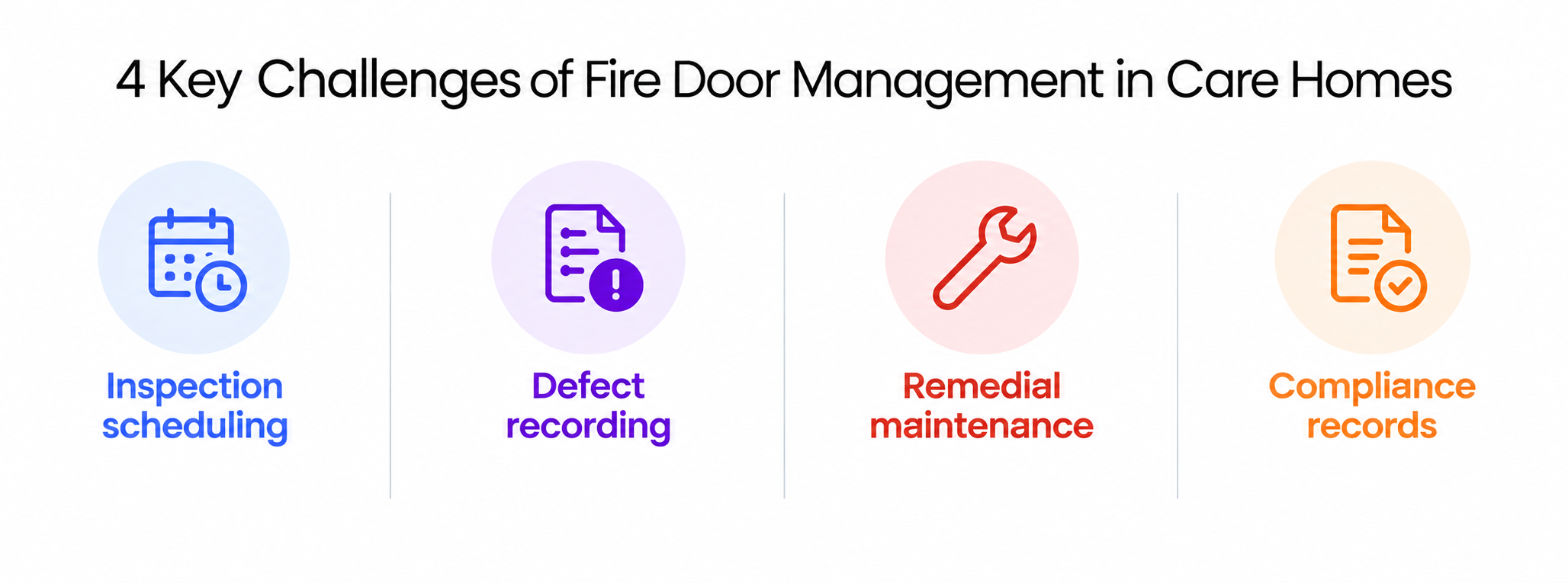
When managing dozens or hundreds of fire doors, it can be difficult to maintain visibility over which doors have been inspected and which require attention. Spreadsheets, paper records and disconnected systems can make it harder to identify overdue inspections or maintain consistent records.
Common defects include faulty door closers, damaged seals, excessive gaps, damaged frames and unsuitable ironmongery. These defects need to be recorded accurately, with sufficient information to support appropriate assessment and remedial action.
Identifying a defect is only the first stage. Maintenance managers must also arrange appropriate remedial work, monitor progress and retain evidence of completion. Where specialist work is required, this may involve coordinating external contractors while minimising disruption to residents and staff.
Inspection reports, maintenance records and evidence of completed work may be needed to demonstrate how fire safety risks are being managed. When records are stored across emails, spreadsheets and paper files, retrieving the information can become time-consuming. For organisations managing multiple care homes, a consistent digital approach can make these processes easier to control.
A centralised fire door asset register can provide maintenance managers with a clearer understanding of the fire doors across their premises. Instead of relying on separate documents or incomplete records, each fire door can be managed as an individual asset.
A useful fire door register may include:
This information can help maintenance managers identify recurring problems, monitor outstanding work and make better-informed decisions about future maintenance expenditure. For care home groups operating multiple sites, a consistent asset register also makes it easier to compare maintenance requirements across properties. The objective is simple: know which fire doors you have, understand their condition and maintain visibility over what needs to be done.
One of the biggest challenges in fire door maintenance is ensuring that identified defects are followed through to resolution. An inspection report may identify several issues, but without a structured process, tasks can be delayed, overlooked or become difficult to track. A digital maintenance management system can help connect the different stages of the process.
Inspection findings can be associated with the relevant fire door asset, creating a clear record of the door's condition at the time of assessment.
Where an issue is found, a remedial maintenance task can be created and linked to the affected door.
Tasks must be allocated to the appropriate maintenance team member or competent external contractor.
Maintenance managers can track which issues remain outstanding, which are in progress and which have been completed.
Records of completed work, photographs and relevant supporting documentation can be retained against the asset. This approach provides greater visibility and accountability throughout the maintenance process. It also reduces the risk of inspection findings becoming disconnected from the work required to address them.
Although the changes to Approved Document B are scheduled for September 2029, maintenance managers do not need to wait until then to improve their fire door management processes. Here are five practical steps to consider in 2026.
Start by establishing whether you have a complete and accurate record of fire doors across your care home or property portfolio. Identify gaps in asset information, inspection history and available certification evidence.
Ensure that fire door inspection arrangements are appropriate to the building's fire risk assessment and operational requirements. Consider whether inspection schedules are easy to manage and whether overdue inspections can be identified promptly.
Review how defects are reported, assigned and followed through to completion. A consistent process can help ensure that identified issues receive appropriate attention and are not lost between inspections and maintenance activities.
Consider whether inspection reports, photographs, contractor records and maintenance histories can be accessed easily when required. Keeping information together can reduce administrative work and support more effective compliance management.
When preparing refurbishment budgets or replacement programmes, take account of the upcoming changes to fire resistance classification guidance. Ensure that future doorsets are appropriately specified and supported by the evidence required for the relevant project. These steps can help maintenance teams improve existing arrangements while preparing for future requirements.
For care home groups operating several properties, fire door management can become particularly complex. Different sites may have different inspection schedules, maintenance requirements, contractors and record-keeping practices. Without a centralised system, estates managers may struggle to obtain a clear overview of compliance-related activity across their portfolio.
A digital fire door management platform can help provide visibility over:
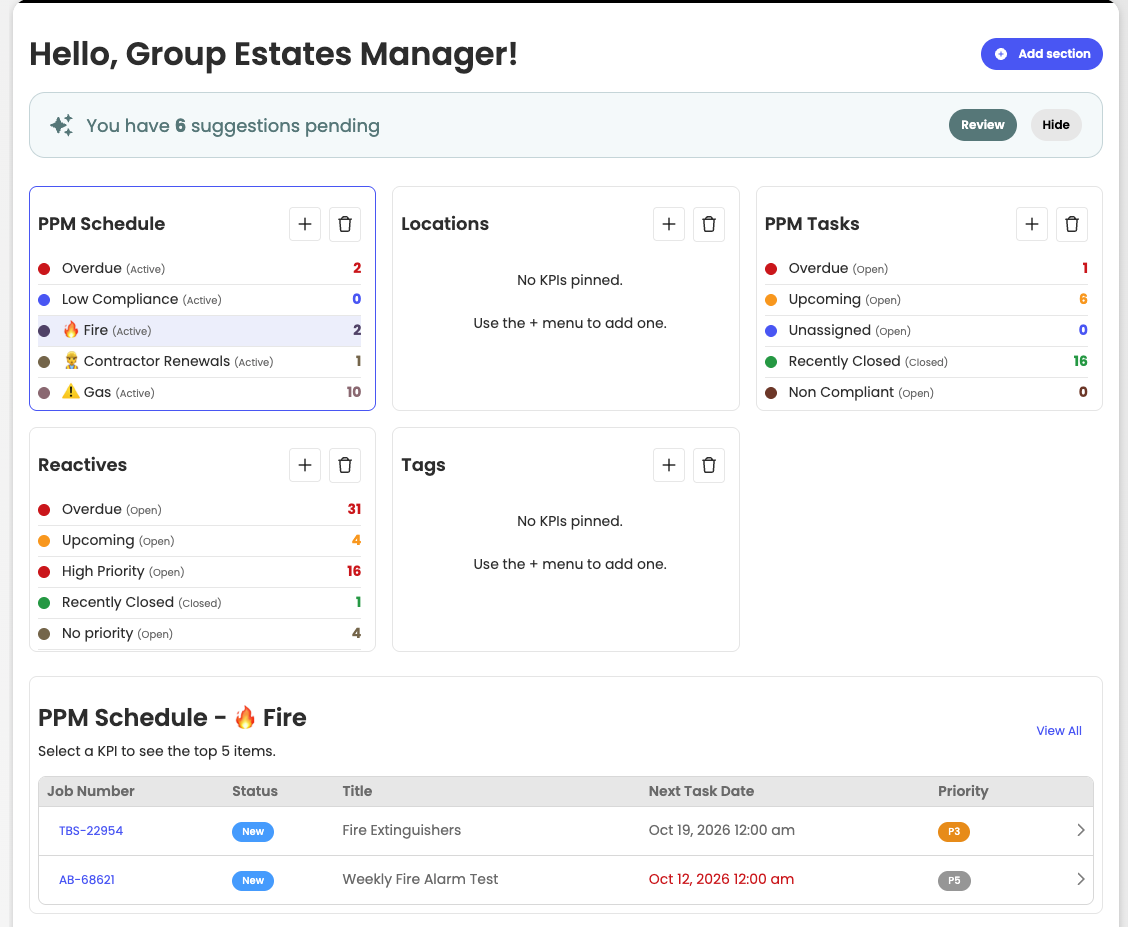
This can help estates teams identify recurring issues, prioritise resources and maintain a more consistent approach across their buildings. For organisations responsible for multiple care homes, having reliable information in one place can also support maintenance budgeting and longer-term asset planning.
Managing fire door compliance should not mean chasing spreadsheets, searching through emails or struggling to find inspection records. FaultFixers helps care home maintenance and estates teams bring their fire door management processes together in one centralised digital platform. With FaultFixers, teams can manage a centralised fire door asset register, schedule inspections, generate remedial maintenance tasks and retain a clear record of completed work. By connecting fire door assets with inspection activity and maintenance tasks, FaultFixers helps provide greater visibility over the work required to keep fire doors appropriately maintained. For care home operators managing multiple sites, this means a more consistent approach to tracking fire door maintenance activity across their property portfolio.
Reduce reliance on disconnected spreadsheets, emails and paper-based records. FaultFixers supports the processes and documentation involved in managing fire safety responsibilities. Appropriate fire risk assessments, competent inspections and suitable remedial work remain essential to achieving compliance.
The upcoming 2029 changes provide an opportunity for care home maintenance managers to review how they manage fire door safety. However, the most important responsibilities already exist today. Fire doors need to be appropriately maintained, identified defects must be addressed and reliable records should be available to support ongoing fire safety management. For care homes, where residents may depend on effective compartmentation and assisted evacuation, these responsibilities are especially important. With FaultFixers, care home maintenance managers can simplify inspections, improve remedial task tracking and keep their fire door maintenance records organised in one place.
Whether you're responsible for a single care home or hundreds of properties, having greater visibility over your fire door assets can help you manage maintenance more effectively. Take control of your fire door maintenance management with FaultFixers.
BS 8214:2026 is referenced as the updated edition of British Standard guidance relating to timber-based fire door assemblies. Its publication details and precise requirements should be checked against the official BSI publication before relying on them in a specification or compliance decision.
No. Existing FD30 fire doors do not automatically require replacement because the guidance changes. Their continued suitability depends on their condition, required performance and the building's fire safety arrangements.
There is no single universal statutory inspection frequency for every care home fire door. Inspection arrangements should be informed by the premises' fire risk assessment, door condition, usage and relevant guidance.
A fire door asset register is a record of fire doors within a building or property portfolio. It can include door locations, available certification information, inspection records, identified defects and maintenance history.
Fire door management software can help care home maintenance teams organise asset records, schedule inspections, track remedial tasks and retain maintenance documentation in one centralised system.
No. Software can support record-keeping, accountability and maintenance coordination, but compliance also depends on appropriate fire risk assessments, competent inspections, suitable fire doors and effective remedial work.