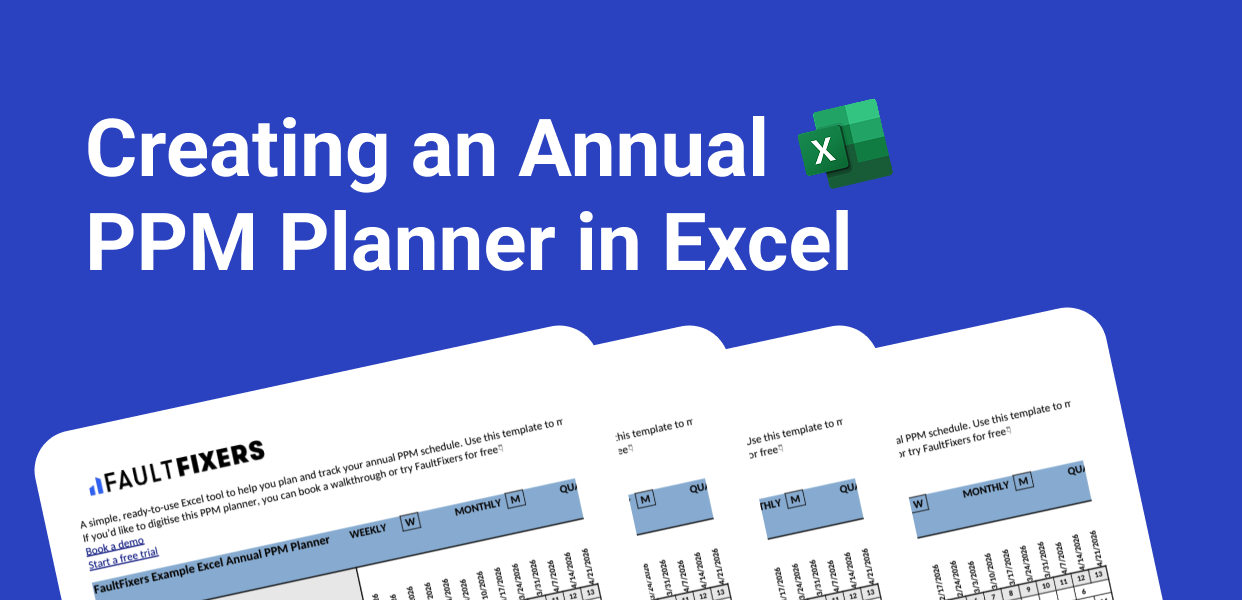
The Facilities Team's Guide to a Preventive Maintenance Audit (With Checklist)

Learn how to run a preventive maintenance audit for your facilities team including a step-by-step checklist, key KPIs to track, and how often to do it.
The Facilities Team's Guide to a Preventive Maintenance Audit (With Checklist)
Written by
Tom O'Neill
Published on
April 27, 2026

Your planned preventive maintenance (PPM) programme is only as good as the last time you properly reviewed it.

For facilities teams, a preventive maintenance audit is one of the highest-leverage things you can do. Done well, it eliminates wasted spend, catches compliance gaps before they become serious, and keeps your assets running longer with fewer emergency callouts. Done poorly or not at all and your PM schedule quietly drifts into inefficiency while your budget absorbs the cost.

There are multiple advantages of managing your preventive maintenance effectively. This guide covers what a preventive maintenance audit actually is, why it matters specifically for facilities teams, and how to run one that produces real results. We've also included a practical checklist you can use straight away.

What Is a Preventive Maintenance Audit?

A preventive maintenance audit is a structured review of your PM programme - its tasks, schedules, documentation, compliance, and outcomes, to determine whether it's working as it should. It's not a routine inspection. Inspections check the condition of your assets. An audit checks the condition of your maintenance programme itself.

Specifically, a PM audit asks:

  • Are the right maintenance tasks being done at the right intervals?
  • Are tasks being completed on time, by qualified people, and documented properly?
  • Is the programme compliant with relevant health, safety, and regulatory standards?
  • Are resources such as time, budget, and parts being used efficiently?
  • Which tasks are genuinely preventing failures, and which are just adding work?

For facilities teams managing buildings, infrastructure, and equipment across one or more sites, these questions translate directly into operational and financial outcomes.

Why Facilities Teams Can't Afford to Skip PM Audits

1. A significant portion of your PPM tasks may be unnecessary

Industry research consistently shows that many organisations are over-maintaining some assets while under-maintaining others. Analyst estimates suggest that up to 30% of preventive maintenance tasks in a typical programme are performed too frequently relative to the actual risk of failure. For a facilities team already stretched thin, that's meaningful capacity being consumed on low-value work.

2. Compliance exposure is real

Facilities teams face regulatory requirements around fire safety, electrical systems, HVAC, water hygiene (including Legionella), lifts, and more. A PM audit verifies that your maintenance schedules align with statutory and insurance-mandated intervals - and that the documentation to prove it actually exists. Research from the Aberdeen Group indicates that organisations that conduct regular PM audits achieve compliance audit pass rates around 90%, compared to roughly 68% for those that don't.

3. Reactive maintenance is expensive and often preventable

When assets fail unexpectedly, the cost isn't just repair. It includes downtime, emergency contractor rates, disruption to building occupants, and potential safety incidents. A PM audit identifies the gaps in your programme that are allowing preventable failures to occur.

4. Your PM schedule was built with the information available at the time

Manufacturer intervals, legacy assumptions, and previous team preferences all shape a PM schedule. An audit gives you a structured opportunity to test those assumptions against actual asset performance data and update them accordingly.

How Often Should You Audit Your PM Programme?

Most facilities professionals recommend a full audit at least annually, with lighter reviews every six months. In practice, the right frequency depends on:

  1. The complexity of your portfolio - a single office building warrants less frequent auditing than a multi-site estate with critical infrastructure
  2. Your current compliance obligations - higher regulatory risk means more frequent verification
  3. Recent changes - new assets, refurbishments, occupancy changes, or contractor switches all create a case for an interim audit

A good rule of thumb: if your unplanned maintenance is running above 30–40% of total maintenance activity, treat that as a trigger to audit your PM programme regardless of your calendar schedule.

The Preventive Maintenance Audit Checklist for Facilities Teams

Work through each section. Rate your current state as Good, Needs Improvement, or Not in Place.

Section 1: Documentation & Records

  • PM schedules exist for all critical assets and statutory equipment
  • Work order records are complete, accurate, and up to date
  • Maintenance logs include task details, completion dates, technician names, and any observations
  • Equipment manuals and OEM maintenance guidelines are accessible and referenced
  • Compliance certificates and statutory inspection records are filed and current
  • Records are stored in a centralised system (CMMS or equivalent) rather than spreadsheets or paper

What to look for: Missing or incomplete records are both a compliance risk and a sign that maintenance tasks may not be happening as planned.

Section 2: Schedule Adequacy

  • PM intervals are aligned with manufacturer recommendations and statutory requirements
  • High-criticality assets are maintained more frequently than low-criticality assets
  • PM schedule reflects actual asset usage (hours-based or usage-based triggers where appropriate), not just calendar dates
  • Seasonal maintenance tasks (e.g. boiler servicing, cooling system preparation) are scheduled appropriately
  • Recent changes to the building or estate are reflected in the current PM schedule

What to look for: Intervals that haven't been reviewed in 2+ years are likely either too frequent in some areas or too infrequent in others.

Section 3: Task Completion & Compliance

  • PM task completion rate is being tracked (target: 95%+)
  • Overdue PMs are flagged, escalated, and resolved promptly
  • Planned vs. actual completion rates are reviewed regularly
  • There is a clear process for handling tasks that cannot be completed as planned

Key KPI: PM completion rate = (PMs completed on time ÷ PMs scheduled) × 100. Below 85% is a red flag.

Section 4: Asset Criticality

  • All assets have been categorised by criticality (e.g. critical, important, standard)
  • Criticality ratings are reflected in maintenance frequency and priority
  • Critical assets are identified: those that present safety risks if they fail, are costly to repair, or directly impact building operations/occupant welfare
  • There is a documented escalation path for failures of critical assets

Common facilities examples of critical assets: fire suppression systems, emergency lighting, lifts, main electrical distribution, HVAC serving critical spaces, water systems with Legionella risk.

Section 5: Safety & Compliance

  • All PM tasks involving statutory obligations are clearly identified and scheduled
  • Relevant statutory inspections are current (e.g. LOLER, PSSR, fixed wire testing, PAT, gas safety)
  • Safety procedures are documented and communicated to all maintenance personnel
  • Contractor competency checks are in place for specialist PM work
  • Risk assessments are linked to relevant maintenance tasks

What to look for: Any lapse in statutory compliance represents direct legal and insurance risk - these should be the first priority in any audit.

Section 6: Parts & Inventory

  • Critical spare parts are stocked and their levels are monitored
  • Parts usage history is tracked and informs reorder decisions
  • Parts procurement is timely enough to avoid maintenance delays
  • There is a process for disposing of obsolete or unused stock

What to look for: Repeated delays due to parts availability often indicate a procurement or inventory management gap rather than a scheduling problem.

Section 7: Team & Contractor Competency

  • Maintenance personnel have the skills and qualifications required for their assigned tasks
  • Training records are current and up to date
  • Specialist tasks are assigned to appropriately qualified contractors
  • Contractor performance is reviewed regularly

Section 8: Cost & Budget

  • PM costs are tracked by asset category and task type
  • Planned maintenance spend is being compared against actuals
  • The ratio of planned to reactive maintenance costs is being monitored
  • There is a process for identifying tasks that could be reduced in frequency without increasing risk

Key KPI: Planned maintenance as a percentage of total maintenance spend. Industry benchmark is 70–80% planned vs. reactive. A lower ratio suggests insufficient PM activity or poor scheduling.

Section 9: Technology & Data

  • A CMMS or facilities management platform is in use and actively maintained
  • Work orders, schedules, and asset records are centralised
  • KPIs and performance reports are generated and reviewed regularly
  • Data is being used to inform PM schedule adjustments, not just to record completions

What to Do With Your Audit Findings?

An audit is only useful if it results in action. Once you've worked through your checklist:

  1. Prioritise your findings. Split them into critical (statutory/safety compliance), important (operational risk), and improvements (efficiency opportunities). Address critical findings immediately.
  2. Create an action plan. For each finding, document what needs to change, who owns it, and by when. Keep this simple - a task list in your CMMS is sufficient.
  3. Adjust your PM schedule. Increase intervals where assets are consistently found in good condition. Decrease intervals where inspection findings suggest faster deterioration. Remove tasks that serve no demonstrable purpose.
  4. Update your documentation. Any changes to schedules, procedures, or responsibilities need to be reflected in your records.
  5. Set a review date. Don't wait another 12 months to check whether the changes are working. Schedule a lighter review 3–6 months after your audit to assess progress.

Making Preventive Maintenance Audits Easier

The single biggest obstacle to effective PM auditing is data quality. If your maintenance records are scattered across spreadsheets, paper-based job cards, and email threads, assembling a clear picture of what's been done and what hasn't takes longer than the audit itself.

A modern facilities management platform centralises your work orders, PM schedules, asset records, and compliance documentation in one place. That means your audit becomes a matter of reviewing live data rather than hunting through filing systems and your findings can be acted on within the same system.

If your current tooling makes auditing difficult, that's worth factoring into your action plan.

Summary

A preventive maintenance audit isn't about adding more work to an already full schedule. It's about making sure the work you're already doing is the right work, done at the right time, with a clear record that it happened.

For facilities teams, the payoff is straightforward: fewer emergency callouts, better compliance, longer asset life, and a maintenance budget that's being spent where it actually matters.

Run your first audit using the checklist above. You may be surprised what you find.

Download Our Preventative Maintenance Excel Template
Want a template to work from? Download our Excel Maintenance Template
Read about our privacy policy.
Oops! Something went wrong while submitting the form.
GET STARTED TODAY

Try our Maintenance Software for Free

Try our digital maintenance management software for free. Set up your facilities, import your asset information and invite your team members for free.
Icon for debit card
No Credit Card Required
Icon for cancel
Cancel Anytime