Every maintenance team wants to reduce downtime, improve asset reliability, and avoid costly reactive repairs. Whether you're responsible for a school, care home, manufacturing facility, commercial property, or multi-site estate, adopting the right maintenance strategy can have a significant impact on operational efficiency and long-term costs.
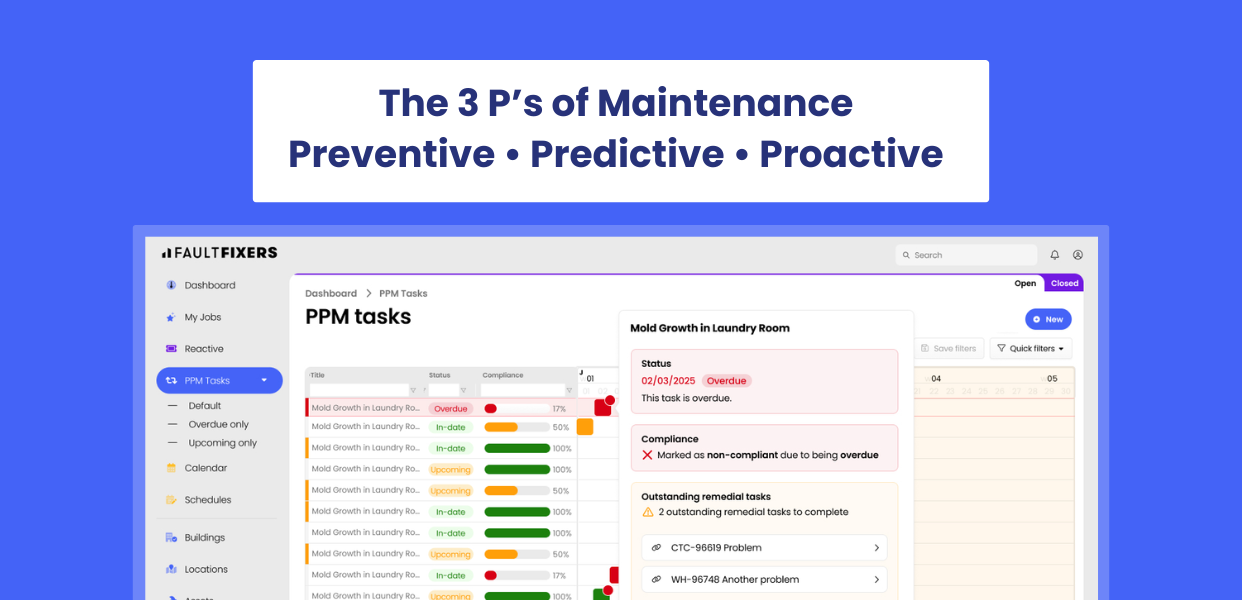
One of the simplest frameworks for building an effective maintenance programme is the 3 Ps of Maintenance: Preventive Maintenance, Predictive Maintenance, and Proactive Maintenance.
While these approaches are often discussed individually, they deliver the greatest value when used together. Preventive maintenance reduces the risk of failures, predictive maintenance uses real-time data to identify potential issues before they occur, and proactive maintenance focuses on eliminating the root causes of recurring problems.
In this guide, we'll explain what each approach involves, how they differ, and how organisations can combine all three to build a smarter, more reliable maintenance strategy.
The three Ps represent different approaches to maintenance planning. Rather than replacing one another, they complement each other to reduce downtime, improve asset performance, and extend equipment life.
Organisations that combine all three approaches often experience fewer breakdowns, lower maintenance costs, and greater visibility across their assets.
Preventive maintenance is the foundation of every successful maintenance programme. Rather than waiting for equipment to fail, maintenance activities are scheduled at regular intervals based on time, usage, or manufacturer recommendations.
The objective is simple: identify and resolve minor issues before they develop into expensive failures.
A well-planned preventive maintenance programme can help organisations:
An effective preventive maintenance programme should include:
Creating a preventative maintenance plan requires assessing your facility’s needs, understanding equipment lifecycles, and setting up a regular schedule. Think of it as a routine check-up, much like taking a car for regular service to avoid a breakdown on the highway. By sticking to a preventative plan, you’re not only safeguarding your assets but also ensuring a seamless experience for everyone who relies on your facility.
Predictive maintenance builds on preventive maintenance by using real-time asset data to determine when maintenance should be carried out. The data is then fed into predictive analytics models, which can forecast when a machine or system might be at risk of failing. Rather than replacing parts or performing check-ups based on a set schedule, you’re making decisions based on actual data insights.
These technologies help maintenance teams detect early warning signs before failures occur.
Predictive maintenance enables organisations to:
Predictive maintenance is particularly valuable for:
While predictive maintenance offers significant advantages, it typically requires greater investment in monitoring equipment and software than preventive maintenance alone. In short, predictive maintenance gives facilities managers the information they need to act before a problem arises.
Proactive maintenance takes maintenance management one step further. Rather than simply fixing problems or predicting failures, proactive maintenance focuses on understanding why failures occur and preventing them from happening again. It’s about empowering everyone involved to identify and address maintenance needs as they arise, fostering a culture where maintenance is everyone’s responsibility.
This often involves:
Instead of replacing the same failed component every few months, maintenance teams investigate the underlying cause and implement a permanent solution. Instead of waiting for a piece of equipment to completely malfunction, proactive maintenance might mean fixing a minor leak before it turns into water damage, or replacing a flickering light before it goes out entirely.
Organisations adopting proactive maintenance often experience:
A proactive maintenance culture also encourages staff to report issues early, capture maintenance history, and continually improve maintenance processes.
Although these strategies share similar goals, they differ in how maintenance decisions are made.
Most organisations benefit from using all three approaches together rather than relying on a single strategy.
Modern maintenance management software makes implementing the three Ps significantly easier.
Rather than relying on spreadsheets or paper records, maintenance teams can centralise maintenance planning, asset information, inspections, and reporting within a single platform.
Facilities management and CMMS software can support the three Ps by providing:
Having access to accurate maintenance data allows organisations to move away from reactive maintenance and build a more structured, data-driven maintenance strategy.
Each of the 3 P’s - Prevention, Prediction, and Proactivity - offers a different perspective on maintenance, but they’re at their best when combined. Together, they create a comprehensive approach that keeps facilities running smoothly, minimises downtime, and maximises the lifespan of equipment and assets.
Adopting all three creates a well-rounded maintenance strategy that’s efficient, effective, and sustainable.
The three Ps of maintenance are Preventive Maintenance, Predictive Maintenance, and Proactive Maintenance. Together they help organisations reduce equipment failures, improve asset reliability, and optimise maintenance planning.
Preventive maintenance is performed at scheduled intervals regardless of equipment condition. Predictive maintenance uses real-time asset data to determine when maintenance is actually required.
No. Preventive maintenance follows a planned schedule, while proactive maintenance focuses on identifying and eliminating the root causes of recurring equipment failures.
Most organisations achieve the best results by combining all three approaches. Preventive maintenance provides the foundation, predictive maintenance improves decision-making through data, and proactive maintenance drives long-term reliability improvements.
Yes. Modern CMMS and facilities management software helps organisations schedule preventive maintenance, monitor asset performance, manage work orders, record maintenance history, and analyse maintenance trends to support all three maintenance strategies.
The 3 Ps of Maintenance provide a practical framework for building a more effective maintenance strategy. Preventive maintenance reduces the likelihood of failures, predictive maintenance uses data to identify issues before they occur, and proactive maintenance focuses on eliminating recurring problems altogether.
Organisations that combine these approaches are better equipped to reduce downtime, improve asset reliability, and make informed maintenance decisions that support long-term operational success.
If you're looking to simplify maintenance planning and bring all three approaches together in one place, modern facilities management software can help centralise maintenance schedules, asset information, reporting, and compliance across your organisation.